Affichage des articles dont le libellé est New Material. Afficher tous les articles
Affichage des articles dont le libellé est New Material. Afficher tous les articles
mercredi 18 mai 2016
A Student In Iceland May Have Just Saved The Planet
Americans throw away 35 billion plastic bottles every year and that’s a problem because it takes plastic around 450 years to decompose, which is kind of a long time. Ari Jónsson is a product design student who studies at the Icelandic Academy of Arts. Recently he came up with a way to create a completely biodegradable water bottle using red algae powder.
Ari Jónsson exhibited his biodegradable bottle at a design festival in Reykjavik earlier this month.
Ari Jónsson exhibited his biodegradable bottle at a design festival in Reykjavik earlier this month.


mercredi 6 avril 2016
Precious plastic
Let people in every corner of the world know they can start their own local plastic workshop.
Go to visit >>>> preciousplastic.com
lundi 18 janvier 2016
San Francisco’s Walls Are Taking Fight Back to Public Urinators
PSFK by Azalea Pena
San Francisco has the ultimate weapon in combatting the city’s growing problem of public urination. Anyone who will try to relieve themselves publicly will now get what’s coming to them. Mohammed Nuru, San Francisco Public Works Director, has started the campaign to paint walls with pee-repellent paint that will make every public urinator think twice about their next move.

Nuru expressed his dismay about this dirty problem in San Francisco. “Nobody wants to smell urine. We are trying different things to try to make San Francisco smell nice and look beautiful,” he told SF Gate.
Back in 2002, a legislation banning public urinating was passed. Violators are subject to pay fines ranging from $50 to $500. However, this persistent problem continues to plague San Francisco. According to SF Gate, Public Works has received 375 requests to steam-clean pungent smelling alleyways and walls since January. This comprises five percent of the total requests made to Public Works to clean up the streets.
San Francisco has the ultimate weapon in combatting the city’s growing problem of public urination. Anyone who will try to relieve themselves publicly will now get what’s coming to them. Mohammed Nuru, San Francisco Public Works Director, has started the campaign to paint walls with pee-repellent paint that will make every public urinator think twice about their next move.
Nuru expressed his dismay about this dirty problem in San Francisco. “Nobody wants to smell urine. We are trying different things to try to make San Francisco smell nice and look beautiful,” he told SF Gate.
Back in 2002, a legislation banning public urinating was passed. Violators are subject to pay fines ranging from $50 to $500. However, this persistent problem continues to plague San Francisco. According to SF Gate, Public Works has received 375 requests to steam-clean pungent smelling alleyways and walls since January. This comprises five percent of the total requests made to Public Works to clean up the streets.
Changing the Way We Walk the Earth for a Cleaner Future
The textile market has become an increasingly progressive arena for innovation. In line with industry objectives and technological advancements, one designer aims to redefine the way in which textiles are produced, consumed and recycled. Designer Ammo Liao has developed the Bio-Knit—a single material that takes on multiple physical properties—in hopes to reshape the current sneaker industry.
PSFK by Christina Mauro

mardi 12 janvier 2016
Adidas and parley launch 3D printed shoe made from collected ocean plastic waste

adidas and parley launch 3D printed shoe made from collected ocean plastic waste
all images courtesy of adidas
at the parley talk at COP21, adidas and parley for the oceans demonstrated how the industry can rethink design and help stop ocean plastic population with a innovative footwear concept – a 3D printed ocean plastic shoe midsole.
Un matériau qui vit et respire comme une feuille d'arbre
Julian Melchiorriil a développé une feuille biologique synthétique, qui absorbe l'eau et le dioxyde de carbone pour produire de l'oxygène tout comme une feuille de plante verte...

"Mon idée était d'utiliser l'efficacité de la nature dans un environnement fabriqué par l'homme," at-il expliqué.
'Je créé un éclairage savec ce matériau, mais en même temps il crée l'oxygène pour nous".
"Il pourrait [également] être utilisé pour les applications extérieures," dit-il. "Vous pouvez absorber l'air de l'extérieur, passer à travers ces filtres biologiques et ensuite amener de l'air oxygéné à l'intérieur."
"Les plantes ne poussent pas à la gravité zéro", explique Melchiorri. "La NASA étudie différentes façons de produire de l'oxygène pour les trajets de longue distance de l'espace pour nous laisser vivre dans l'espace. Ce matériau pourrait nous permettre d'explorer l'espace beaucoup plus loin que ce que nous pouvons maintenant."
De toutes ces possibilités, quelles sont celles qui se concrétiseront?
L'avenir le dira
Le cuir végétal est sur le point de révolutionner l’industrie textile !
Un grand pas en avant est en train d’être franchi grâce à Richard Wool, un ingénieur chercheur des États-Unis, qui a développé un éco-cuir artificiel. L’éco-cuir est produit à partir de fibres naturelles telles que le lin ou le coton mélangé à du maïs, du soja et d’autres huiles végétales, fibres qui sont ensuite assemblées sur plusieurs couches. Le résultat est vraiment probant et très similaire au cuir animal.

lundi 11 janvier 2016
Scientists Have Invented A New Material That Harvests And Stores Solar Heat
The material could enable self-warming clothes and even increase the driving range of electric vehicles.
Researchers at MIT have invented a new transparent polymer film that allows heat to be harvested from the sun and saved for later use. Unlike traditional methods of storing solar energy, which takes heat from the sun and stores it as electricity, the new solar heat-storing transparent polymer film takes the sun’s energy and saves it in a chemical state. Once saved, the stored solar heat can be unleashed via a simple chemical reaction.

mercredi 7 octobre 2015
The World’s First Shoe Upper Made of Ocean Waste

adidas is taking the phrase “one man’s trash is another man’s treasure” to a whole new level. They’ve teamed up with Parley for the Oceans, an organization that aims to raise awareness about ocean pollution. On June 29, 2015, during “Oceans. Climate. Life.”, a talk hosted by United Nations and Parley for the Oceans, adidas unveiled the world’s first shoe upper made solely from recycled ocean waste and illegal deep-sea gillnets.
mardi 6 octobre 2015
Trnasparent Solar Panel Windows

This Innovation Turns Solar Cell Technology Completely Transparent
At first the technology altered the color and transparency of glass, giving off a kaleidoscope effect that was not very natural. However, this process led engineers to discover that they could make the active layer of the system transparent or essentially invisible. How? The solar cell absorbs and transmits light in the ultraviolet and infrared spectrum of wavelengths that the human eye cannot see.
This technology is not limited to windows, but has the ability to replace any glass surface -- smartphone screens, e-readers and laptops could become invisible energy sources that are able to charge themselves. Installed in a home, you could even be able to say goodbye to dreaded electricity bills.
mardi 1 septembre 2015
Vibram Unveils the Bizarre Furoshiki Wrap-Around Shoe

Industry standard sole manufacturer Vibram has unveiled a bizarre
new footwear contraption. The Furoshiki shoe takes inspiration from the
Japanese tradition of wrapping objects in cloth, and consists of a
gripped sole unit which wraps around the foot with stretchy straps,
making an innovative, adaptable shoe that Vibram promises will provide
“comfort in every environment.” The shoe sports an anatomically-designer
sole which promises to accommodate all foot shapes without sacrificing
grip or comfort, and was originally designed for use in the water
sports.
Head to the Furoshiki Shoes website for more information and the chance to cop – although be warned, the website is mainly in Japanese.
mercredi 29 juillet 2015
Thermo color map displays attractions according to weather conditions

‘bath °C thermo color map’ by camilla hempleman is a hand held activated map, based on her home city of bath, england. using thermochromic inks and tyvek fabric the map is activated at different temperatures, revealing layers of hand illustrated buildings and attractions, showing the best places to visit depending on the weather. designed as a roll map, the fabric is water, and crumple proof allowing it to be easily stored in your bag with minimal packaging to combat any excess waste. the map is color coded to specific external environmental temperatures, which allows tourists, visitors and residents a like to have a new experience of bath.
mardi 21 juillet 2015
Chao chen creates biomimetic water-reactive material using pine cones

Nature has the answers to all of life’s problems if one looks close enough; the pine cone is no different. in order to protect and release its seeds, the cone has the ability to open and close its surface in reaction to water. its outer layer has a higher hygroscopic expansion ratio than the inner therefore causing, when dry, it to elongate outwards and release its seeds amidst optimum conditions.

veneer and nylon/polyester/styrene combined creates a bilayer material which can imitate the pine cone
mardi 7 juillet 2015
Power-Producing Rubber
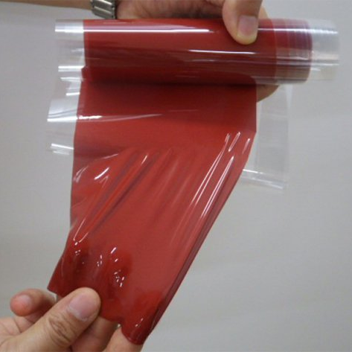
No, this is not an image of a delicious Fruit Roll-Up, it's actually a unique new flexible material from Ricoh that can create electricity from pressure and vibration. Dubbed "Energy-Generating Rubber," this piezoelectric mat combines the best features of existing ceramic and polymeric materials; high energy output and flexibility, respectively. In fact, this new rubber produces just as much power as ceramic does while surpassing the flexibility of polymeric materials, according to Ricoh. What's more, it is more easily produced than either existing form of piezoelectric.
Unfortunately, that's just about everything Ricoh has revealed about the new material so far. The company hopes to further develop the technology into a commercially viable product some point in the future. As such, it is teaming with the Tokyo University of Science to further improve the material's productive capabilities.
Source: engadget.com
jeudi 2 juillet 2015
Google and Levi are turning clothing into touchscreens Read more: Google and Levi are turning clothing into touchscreens | Inhabitat - Sustainable Design Innovation, Eco Architecture, Green Building
Kristine Lofgren

Jacquard is a “smart fabric” developed by Google’s Advanced Technology and Projects (ATAP) group that could conceivably turn your sleeve into a touch screen. The team of digital and textile experts developing this conductive woven yarn want it to look and feel like any traditional garment. But this seemingly normal fashion will interact with digital devices. This is not meant as a tiny initiative either. Their vision is about scale, and allowing interactive fabric to be manufactured with existing processes. To make it all real, Google is partnering with designers, textile mills, and iconic brands like Levi’s.


Jacquard is a “smart fabric” developed by Google’s Advanced Technology and Projects (ATAP) group that could conceivably turn your sleeve into a touch screen. The team of digital and textile experts developing this conductive woven yarn want it to look and feel like any traditional garment. But this seemingly normal fashion will interact with digital devices. This is not meant as a tiny initiative either. Their vision is about scale, and allowing interactive fabric to be manufactured with existing processes. To make it all real, Google is partnering with designers, textile mills, and iconic brands like Levi’s.

Color Changing Skin
Nature does not require dyes and pigments to create colours.
Here is another brilliant example of a new material development for camouflage colours, inspired by nature: Scientists at the University of California, Berkeley/US have created a thin, flexible material that changes colour when stretched or bent. It has potential for the future of camouflage The artificial skin was inspired by chameleons, and doesn’t involve any synthetic dyes or pigments. Physical effects can do the job.
The new material, a high-contrast metastructure (HCM), is made from silicon metastructures. It can be made to change color — on demand — by simply applying a minute amount of force. The Berkeley scientists call it “Flexible photonic metastructures for tunable coloration”.
The new material’s application is in creating adaptable camouflages that can change to adapt to various backgrounds. This new material offers exiting possibilities for an entirely new class of display technologies, color-shifting camouflage on textiles and other surface materials, and sensors that can detect otherwise imperceptible defects in buildings, bridges, and aircraft.
The material works by creating “structural colour” which is controlled by tiny scales or features on the surface of an object, which interact to reflect particular wavelights depending on their spacing. Structural colours is how butterflies create colours, how human eyes are coloured, and how chameleons control their skin tone.
Even the chameleon´s ability to create colours to their colors rapidly, has only been recently understood. Chameleons, unlike the squid and the octopus, do not modify their scaly hues by altering the pigments in their skin cells. The mysterious color-change abilities are actually attributed to a layer of special skin cells which contain light-reflecting nanocrystals.
Once again, we learn that nature does not require synthetic dyes and pigments to create colour effects, and that technology can get inspired from nature´s abilities to invent new concepts and develop innovative materials. Perhaps the future of colouration effects will be without dyes and pigments.
Source: blog.stepchange-innovations.com
Paper-thin printed solar cells could provide power for 1.3 billion people
by
Greg Beach, 06/17/15
 The cost of solar power has declined dramatically over the past few decades, from $40 per watt in 1977 to $0.74 per watt in 2013. This trend is expected to accelerate
as improvements in efficiency and new technologies come online. This is
good news for citizens of developed countries who want to make the
switch to a cleaner and increasingly cheaper energy source. The shift to
solar may be most dramatic for those living in developing countries.
Thanks to inexpensive printed solar cells, 1.3 billion people currently
without electricity may be able to plug in for the first time.

Paper-thin solar cells require only an industrial printer to manufacture and are inexpensive to produce. Unlike traditional panels, the printed solar cells are flexible, which eases their transportation to rural locations. Printed solar cells have developed rapidly, rising from 3% efficiency to 20 percent in just a few years. “I’ve witnessed first-hand how the technology has enabled urban poor communities in India to access off-grid electricity,” says Scott Watkins of Korean firm Kyung-In Synthetic. “Its success is due to its cost effectiveness and simplicity. A 10×10 cm solar cell film is enough to generate as much as 10-50 watts per square meter.”
However, the mass production and distribution of printed solar cells is not without its obstacles. While the panels are inexpensive to produce, an industrial printer requires a substantial capital investment to acquire. The printed panels can be vulnerable to moisture and may lead to lead contamination if broken. Companies such as Kyung-In Synthetic are testing new coatings for the cells to alleviate these problems. A cooperative system in which community members contribute resources and maintain democratic management of the venture may ensure sufficient start-up capital as well as the establishment of a strong local distribution network. Despite the challenges, printed solar cells are a powerful anti-poverty tool and represent a major step towards a 100 percent renewable energy economy.
Via SciDevNet
Images via NPL
Inscription à :
Articles (Atom)