Affichage des articles dont le libellé est Health. Afficher tous les articles

mercredi 18 mai 2016

What iPhone-Based Health Care Could Look Like In 10 Years

Chronicle, a new concept from the design consultancy Artefact, is like a doctor in your pocket.

<p>Chronicle is a concept for the future of health care.</p>Mark Wilson 03.09.16

 Heart disease, cancer, diabetes, obesity, arthritis—chronic conditions such as these account for 84% of health care spending. Yet many are preventable. An estimated 40% of all premature deaths can be attributed to lifestyle, such as smoking and inactivity. How can the health care system shift focus (and dollars) from acute to preventative care?

The Seattle-based design firm Artefact has created a compelling new concept called Chronicle. It would be the first app to monitor someone’s health across various chronic diseases, as it compares to others with similar conditions, in real time.
"It’s about all this time you’re not actually focused on your condition, sitting in your home doing research about it," says Matthew Jordan, insights and strategy director at Artefact. "Real life is where the biggest risks are, which is why we wanted to think of something like Chronicle."

lundi 18 janvier 2016

Not Impossible Labs Creates Open-Source Technology for Transformational Good

PSFK by Simone Spilka

Not Impossible Labs aims to create accessible technology on an open-source platform in the spaces of mobility, health and communication, and then use storytelling to inspire others to do the same.


The company with a massive vision to do good for humanity first caught our attention when developing the EyeWriter, an open-source software that enabled TEMPT, a paralyzed graffiti artist with ALS, the ability to paint again. The technology, a low-cost pair of eye-tracking glasses, allows TEMPT to control a virtual paint brush by blinking to turn it on and off, and moving his eyes to draw.

PSFK catches up with Not Impossible Labs Founder Mick Ebeling about his new book Not Impossible, the journey in working with TEMPT and other DIY initiatives that have the power to improve the lives of people around the world.

PSFK: Can you tell me about your background and that of Not Impossible Labs?

Mick Ebeling: Not Impossible Labs started after being inspired by TEMPT and creating the EyeWriter, looking at its success and questioning why we shouldn’t do it again.

I’m a political scientist, but I am a producer. Science isn’t my background. The reason we’ve been successful is the way in which we approach things from the perspective of a producer. A producer looks at what needs to be done regardless of whether or not they have the expertise, then figure out how to pull it off.

The Inside of Your Ear Might Prove Key in Getting Pregnant

YONO (You Know) Labs developed an in-ear wearable device that will help women track their ovulation cycles, so that one’s fertility window is best determined. This device should help couples in trying to make a baby and when family planning.


mercredi 13 janvier 2016

50 Millennial Health Innovations


From Smart Connected Inhalers to Posture Correcting Trackers

Published:
The Millennial consumer is focused on health innovation more so than any other consumer segment for a variety of reasons, and here you'll find a collection of the best and brightest grabbing their attention.

When it comes to healthcare and Millennials, it has become strikingly clear that it's all about prevention by using everything from a fitness tracker to maintain health or an app to determine susceptibility to certain illnesses.

Being that Millennials were raised around technology, the further integration of it into their lifestyles is rather intuitive. While Boomers and other segments might deal with issues as they come about, health innovation with the Millennial consumer is all about preventing, mitigating and managing health before it develops into a serious problem.

Breath Sensor Helps Shift Conversation From Weight Loss to Fat Loss

Breath Sensor Helps Shift Conversation From Weight Loss to Fat Loss

A CES 2016 reveal, this breathalyzer will tell you if your workout is actually working or not

Leo Lutero - 11 january 2016
 
LEVL can tell if your body is actually burning off fat. By measuring acetone in the breath, it will be able to tell if your body is doing what you want it to.
The prototype features a dock with two breath pods. To carry out a test, the user would have to breath into one pod and put it into the dock which analyzes the sample. A reading is made and a LEVL score shows up on the dock’s display. This LEVL score serves as a quick summary of how a person is doing in terms of burning fat.
LEVL 1.png

mercredi 11 novembre 2015

Une pilule pourrait bientôt remplacer le sport

Des chercheurs viennent de trouver un moyen de reproduire les réactions d'un corps à une activité physique, rapporte la revue "Cell Metabolism".

Publié le | Le Point.fr
Une pilule pourrait bientôt reproduire les bienfaits d'une séance de sport sur notre organisme.
Une pilule pourrait bientôt reproduire les bienfaits d'une séance de sport sur notre organisme. © ISOPIX/SIPA
Les plus fainéants d'entre nous vont l'adorer. Une pilule miracle, capable de reproduire les bienfaits d'une séance de sport sur notre organisme, pourrait bientôt voir le jour, révèle la revue Cell Metabolism. Au total, deux équipes de chercheurs, l'une basée au Danemark et l'autre en Australie, travaillent actuellement sur ce projet.
On le sait depuis longtemps : le sport a de nombreux bienfaits sur le corps. Malheureusement, tout le monde n'a pas la possibilité de pratiquer une activité physique. Les personnes obèses ou amputées ont les plus grandes difficultés à bouger au quotidien. Or, comme le soulignent les professeurs David James, Leonard Ullmann et Charles Perkins au journal Science Daily, le sport "est une des thérapies les plus puissantes pour de nombreuses maladies, y compris le diabète de type 2, les problèmes cardiovasculaires ou certains troubles neurologiques". Et d'ajouter qu'il est donc "essentiel de trouver un moyen de créer un médicament qui imite les bénéfices de ces exercices". Aujourd'hui, c'est peut-être bientôt chose faite.

dimanche 11 octobre 2015

3D Printed Casts

3D Printed Casts

This 3D-Printed Cast Excels the Healing Process of Broken Bones

Published: • References: linkedin & fastcodesign
Senior director of functional design at '3D Systems' Scott Summit created a unique 3D-printed cast. The cast is more comfortable than traditional fiberglass casts and will actually enhance the healing process.

This 3D-printed cast allows the healing process to be more efficient by reducing the weight of the cast and the amount of skin that is acutally covered. After injuring himself, Summit and an orthopedic surgeon scanned his arm and built a 3D cast that would rest on just three parts of his arm. By avoiding major nerves, the cast reduced the constricted blood flow and swelling to allow a faster healing time.

The fresh cast designs allows users to easily shower and remain together in both hot and cold water temperatures. This cast even allows the wearer to conduct daily tasks like playing the guitar and slicing veggies.

vendredi 9 octobre 2015

Women in China Wear the ‘Facekini’ in New Beach Trend


1
Zhang Shifan tries on a face-kini mask as she demonstrates her products at an exhibition in Qingdao, Shandong province, China, May 22, 2015. (Photo by Reuters/Stringer)

2

jeudi 8 octobre 2015

Smart Stairs Marking in Utah Valley University


Utah Valley University students walks along the bright green lanes painted on the stairs to the gym Thursday, June 18, 2015, at Utah Valley University, in Orem, Utah. Utah Valley University spokeswoman Melinda Colton said the green lanes were intended as a lighthearted way to brighten up the space and get students attention. (Photos by AP Photo/Rick Bowmer)

Exercise-Dependendant Water Machines

Exercise-Dependendant Water Machines

The Singapore-based non-profit organization 'Lien AID' recently held a campaign to demonstrate how difficult it can be for many people in the world to access clean drinking water. In many parts of the world, people must travel long distances to find a source of clean water. Lien AID's new campaign sought to educate the Singapore public about how difficult it is for rural people to access water.

The campaign was held on World Water Day and it involved a vending machine called the 'Water Machine.' This smart machine held 160 bottles of chilled drinking water, each of which was available for free. However, in order to receive a bottle of water, an individual had to run in place, do a series of jumping jacks or hold a yoga pose for 45 seconds. Even after the individual performed this task, the machine still wouldn't dispense their bottle of water. The Water Machine would then reveal a story about the hardship that many people endure in order to access clean drinking water, thus instilling the importance of the campaign. 

mardi 6 octobre 2015

Stress-Reducing Coloring Books

Stress-Reducing Coloring Books

These Adult Coloring Books are Designed to Fight High Stress Levels

Published: Jul 14, 2015 • References: runningpress & demilked

These adult coloring books created by Hannah Davies, Richard Merritt and Jo Taylor are designed to reduce stress and increase relaxation. By soothing the cluttered mind of adults and encouraging them to focus solely on the not-so-important task at hand, it can bring peace to their busy brains.

Coloring books are designed to entertain and distract children, but they can do the same for adults. Children are happy to sit and color for hours on end and it is important for adults to retain the simple exercise they once thoroughly enjoyed.

This adult coloring book is certainly not meant for children. Each page presents a wildly intricate drawing of a creature or scene that requires time and commitment to color and complete in full. The idea behind the Creative Therapy books is to bring stress levels down and elevate calmness among adults.

mercredi 29 juillet 2015

Prosthetic arm with LEGO compatibility sparks creativity for kids with disabilities

prosthetic arm with LEGO compatibility sparks creativity for kids with disabilities

‘iko’ is a creative prosthetic system designed for children to explore and empower their creativity in a playful, social and friendly way. partnering with cirec, a foundation for physical rehabilitation, and LEGO future lab, carlos arturo torres tovar developed a hackable product with different modules: socket, battery, docking station with muscle and hand functions.

mardi 21 juillet 2015

En Suède, les donneurs de sang reçoivent un SMS lorsqu’ils sauvent une vie

Une initiative simple mais qui encourage à faire des dons, indispensables aux malades, en mettant en valeur les donneurs. Quand on sait qu’on a aidé concrètement une personne à guérir, le don de sang prend une autre dimension. Pour rappel, en France, 114 malades sont soignés chaque heure grâce aux dons de sang.


Comme nombre de pays développés, la Suède fait face à un déclin du nombre de donneurs de sang. Aussi, pour inciter un plus grand nombre de personnes à faire preuve d’esprit civique, le service suédois de transfusion sanguine a décidé d’envoyer des sms personnalisés à tous les donneurs. Dans un premier temps, ils reçoivent un sms de remerciement lorsqu’ils font un don. Mais ils reçoivent aussi un sms le jour où leur don est utilisé pour sauver la vie d’un patient et où leur sang coule dans les veines d’un autre.

« Nous essayons constamment de développer de nouveaux moyens de souligner l’importance des donateurs" a expliqué Karolina Blom Wiberg, responsable de la communication au service de transfusion sanguine de Stockholm dans une interview au journal britannique The Independant.
Selon les services de transfusion sanguine, les donneurs de sang ont favorablement accueilli cette marque de reconnaissance et cela les a incités à donner leur sang plus souvent. "Cela fait une réelle différence de savoir que ce petit geste a réellement sauvé la vie de quelqu’un".

mercredi 8 juillet 2015

Stress-Monitoring Smartwatches

The 'Embrace' Watch Helps People with Epilepsy Track Their Seizures

Published: • References: facebook & indiegogo
'Embrace' is a revolutionary smartwatch designed to help people with epilepsy monitor their stress, activity and overall balance. The wearable device not only helps people living with epilepsy track their own health, but it also provides alters to loved ones in the event that a seizure occurs.

While Embrace is a high-tech medical device, it is designed to look just like a luxurious smartwatch. Made from Italian leather and polished metal, the device easily tightens on the wearer's wrist for a snug fit. The device will then automatically monitor the physiological stress, sleep and physical activity of the wearer throughout the day. If you push the body beyond its limits, the device will deliver a small vibration to remind you to take it easy. In the event that an unusual event happens, such as a convulsive seizure, the smartwatch will send an immediate alert to the smartphone of friends and family.

For people with epilepsy, Embrace is not only a great way to track their health, it may even be a critical life-saving device.

Bladder-Monitoring Devices

'Brightly' is a Wearable Device for Those Suffering from Incontinence

Published: • References: facebook & wired
According to the CDC, more than half of Americans over the age of 65 are suffering from incontinence, yet there are few options available for managing the condition. 'Brightly' is a new form of wearable technology that is intended to serve as a practical alternative to adult diapers or incontinence surgery.

Brightly is a belt-like device that is embedded with non-invasive biosensors that can monitor the expansion and contraction of the bladder. Because the bladder is essentially a large balloon of conductive tissue, it is one of the easiest organs for technology to monitor externally. As the bladder expands, Brightly uses Bluetooth technology to send a discrete signal to the wearer's smartphone to let them know when it is time to relieve themselves.

While the technology is not the most glamorous product on the market, the wearable device is crucial for giving a sense of dignity and independence back to those suffering from incontinence.

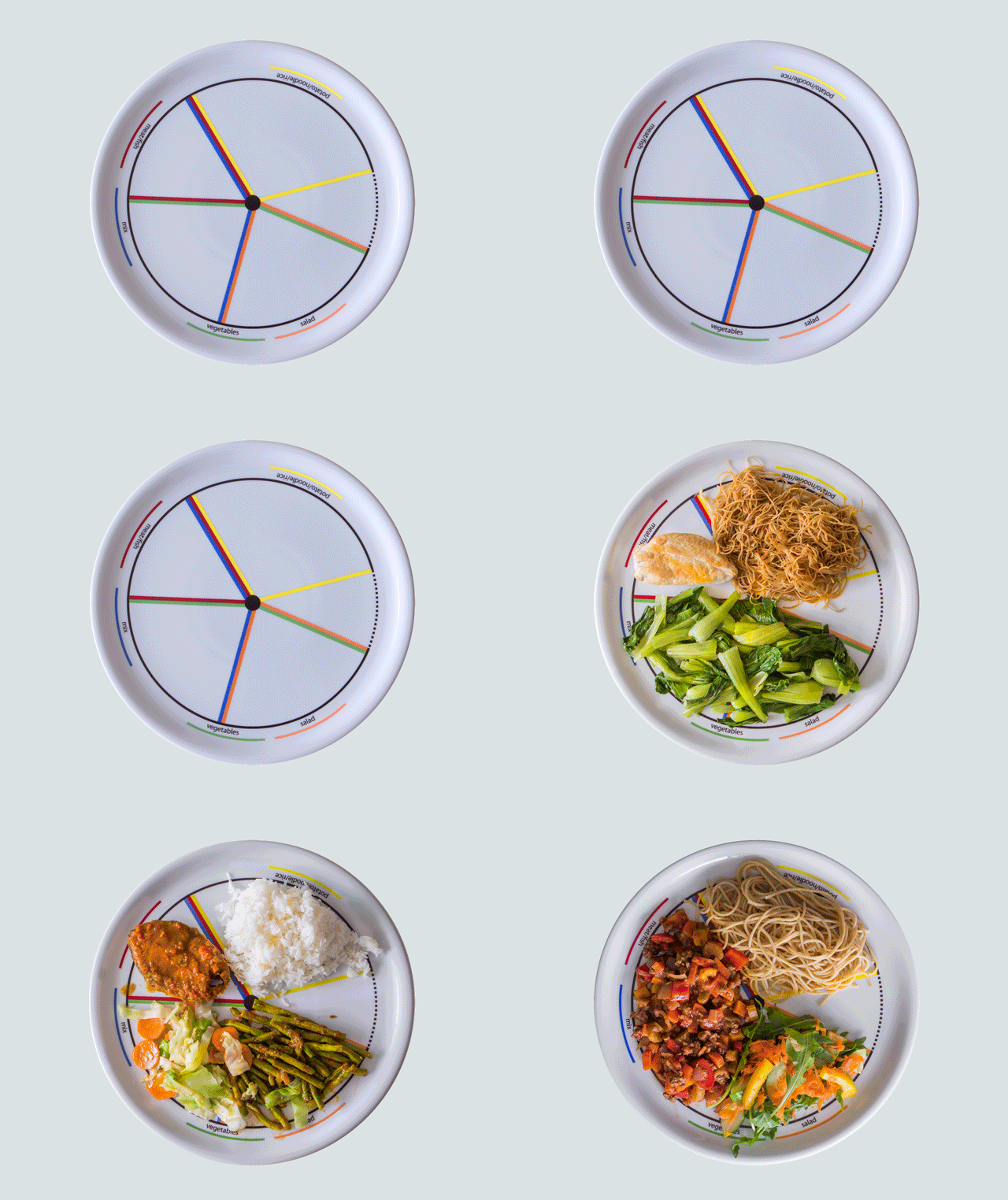
This Simple But Ingenious Plate Stops You From Eating Too Much

No more self-delusion. Your heaping pile of pasta isn't a diet plan—and now your plate will remind you.


It started with a simple idea: If people tend to overeat because they have trouble estimating portion sizes, why not draw portion sizes directly on a plate? Last year, Dutch designer Annet Bruil sketched out a plate that graphically illustrates a balanced meal. Now—with more evidence that the plate can actually help improve nutrition—she's ready to start mass manufacturing.

The ETE plate, which to help fund the first production run, is split into pie chart-like sections, each labeled with examples of the food you can fit inside: Salad, meat or tofu, noodles or rice, vegetables, and an overlapping "mix" section to handle the fact that most dinners combine different food groups. By limiting what you eat to what can fit in each wedge, in theory, you'll become healthier.

mardi 7 juillet 2015

Bionic Lens


A new bionic lens implant could give patients the unique ability to see three times better than standard 20/20 vision for the rest of their lives.
Dr. Garth Webb, founder and CEO of Ocumetics Technology Corp, a company committed to eliminating glasses and contact lenses for patients, invented the Ocumetics Bionic Lens, which resembles a small button.
The lens inside the patient’s eye is removed and replaced with an artificial lens, much like cataract surgery. The process then involves flushing the eye with a saline solution. Just 10 seconds after the implant is in place, the folded lens opens up, moves itself over the eye’s natural lens and vision is improved, the company says.
The lens was created after eight years of research and $3 million in funding for research, international patents and trials. The patent is expected to be available as soon as 2017, as long as clinical trials go as planned.

Source: news.discovery.com

vendredi 3 juillet 2015

Vos médecins s’appelleront bientôt Google, Apple ou IBM

Applications et objets connectés, données médicales stockées dans le « cloud », intelligence artificielle... Le numérique bouleverse la santé, forçant les professionnels à s’adapter, et bientôt à se réinventer. 


Sa voracité est décidément sans limites, et Google démontre chaque jour qu’il mérite le surnom dont il est régulièrement affublé dans les articles le concernant : l’ogre. Après le net, la robotique, la voiture autonome, cet ogre semble en effet bien décidé à conquérir le secteur de la santé. La multiplication de ses annonces l’année dernière en est la preuve.

Hospital Looks to Virtual Reality in Emergency Situations


Immersive technology from Next Galaxy Corporation will train individuals in life-saving procedures

Leo Lutero

Patients and medical professionals will soon be setting aside diagrams and photos in exchange for VR goggles. Content developer Next Galaxy Corporation and the Miami Children’s Hospital has recently forged a multi-year deal for creating immersive virtual reality (VR) instructional content.

Wearable Ergonomic Device Promises Good Posture, Regardless of What Chair You Sit In

When furniture design doesn't involve furniture


I was disappointed to find that my lazy body can defeat even the most expensive ergonomic chair. No amount of fancy adjustable features will stop me from eventually slouching as I become more absorbed in work.I'm not alone in this, and to address the problem, entrepreneur and sciatica-pain sufferer Katherine Krug has collaborated with two industrial designers to produce an object that seems it will end slouching once and for all. Called Better Back, the device is not a chair at all, but a wearable harness that "stabilizes your pelvis, [restores] your spine's natural curvature, and provides lumbar support."