Une formation en ligne unique pour apprendre à créer sa propre serre
bioclimatique d'abondance accolée à son habitation. Pour en savoir plus : http://solutionera.com/serre-dabondance-fr
et voir la video explicative ici : https://www.facebook.com/thierry.regenere/videos/669530019892724/
Published: Aug 11, 2015
This fall, Toronto will be host to a unique dining experience from Stella Artois called the 'Sensorium.'
The three-week experience is one part dining and one part theater, based
around the idea of involving all of the senses when eating and
drinking. A gigantic dome will be set up for the event, which will serve
as the immersive 360-degree theater for the tasting and viewings to go
on. For instance, when eating a course of seafood, projection mapping
will turn the interior of the dome into an underwater environment. Salty
scents from the sea will be projected in order to really recreate the
feeling of being by the ocean.
Considering that tickets have been flying off the shelves and it's
anticipated that more than 2,000 people will attend this unique dining
event, the pop-up dome gives the brand flexibility to bring the
Sensorium to other global cities.
Lucy, a barista at Old Spike Roastery
in London, isn’t your typical coffee shop employee. She’s very
friendly, but she has only just started to learn English. She can make a
mean flat white, yet she learned how to do so only five months ago,
when the shop’s owners hired her right off the street.
And her story is emblematic of the mission at Old Spike, a coffee
roastery founded by Cemel Ezal and Richard Robinson, that focuses on
helping the local homeless population as much as it does on serving up
conscientious cups of joe.
The pair initially began speaking with Lucy—who is originally from Romania—when they saw her selling copies of the Big Issue
outside a train station, drawn in by her consistently positive
attitude. After a few conversations through Google Translate, they
convinced her to join Old Spike as the store’s first barista.
Right now—at this very moment—there are over 7 billion humans
crawling on the Earth. That’s a lot of mouths to feed. To sustain them
all, we’ve taken 40 percent of the planet’s total landmass
and turned it into cornfields and almond orchards, cattle ranches and
orange groves, all to churn out the cereals, produce and meat that feed
humanity.
Unfortunately, that’s left us in a bit of a bind. The world population is expected to grow to 9.6 billion by 2050, and according
to the Food and Agriculture Organization of the United Nations (FAO),
if we want to avoid mass malnutrition, we’re going to have to up our
food production by 70 percent by 2050. The problem is most of the land
we can work for food is already being cultivated.
The rest is atop mountains, covered by desert sands or in Antarctica.
The only potential farmland left would require slashing and burning the
world’s remaining rain forests. That means we’re going to have to make some large-scale changes to how we farm.
It’s not impossible. In fact, it’s been done once before in living memory. Few people have heard of Norman Borlaug,
but if you’re seeking a revolution in farming, he’s probably the first
person you’ll want to look up. In the mid-1940s, wanting to increase
wheat yields in the highlands of south-central Mexico, Borlaug bred
several high-yield, disease-resistant strains of semi-dwarf wheat
well-suited to Mexico’s mountains. Farmers who planted Borlaug’s wheat
saw yields increase immediately; these gains were especially evident
when the crops were planted in soil treated with nitrogen fertilizer.
The method caught on quickly, and by 1963 95 percent of Mexico’s wheat
crop was Borlaug’s dwarf wheat. Between 1944 (the year Borlaug arrived
in Mexico) and 1963, Mexico’s wheat yields sextupled.
Norman Borlaug won the Nobel Peace Prize in 1970 for his
contributions to improved farming and increased food production across
the world.
Avec
notre partenaire Spicee, le nouveau média 100% vidéo. A Berlin, les
habitants laissent ce qu'ils ont en trop dans des frigos en plein air.
Une idée simple contre le gaspillage. Regardez.
Button Gourmet, designed by Mormedi for Coffetek, won over the 38-member jury of the Red Dot Award: Product Design 2015. With Button Gourmet, Mormedi proved its design excellence in one the most important competition for product design, which is celebrating its 60th anniversary this year.
The international experts discussed and assessed each of the 4,928 entries from 56 countries. But only the designs that won over the jury with their quality and innovative power were given an award.
Button Gourmet in an innovative solution that proposes an evolution of self-service towards a 24/7 gourmet experience.
Some say that a good book is best accompanied by a cup of
tea. But this infographic suggests that you should enjoy some dessert
while reading your novel.
Created byBerries.com, the infographic features a list of desserts inspired by the sweet dishes mentioned in famous novels like The Hunger Games, The Help and Harry Potter.
For instance, you can imagine you are at a tea party with the Mad Hatter and the March Hare as you read Lewis Carroll’s Alice’s Adventures in Wonderland and munch on some red jam filled tea biscuits. Or have some lemon cake as you read The Great Gatsby.
Scroll down to see the full list. Which dessert would you look forward to?
As an organization that's responsible for running Canada's
largest food bank, Moisson Montreal began a food recovery program that
is cutting down on huge amounts of food waste.
The initiative involves partnerships with local grocery stores and it
simply reallocates food that stores would otherwise discard on a normal
basis. Since the project began, Moisson Montreal and its grocery store
partners have been responsible for redistributing more than 197 tons of
meat, 137 tons of goods from the bakery, 52 tons of fresh produce and
148 tons of frozen food items. Meat is one of the most difficult food
items to redistribute because of the transportation and refrigeration
required, but it is a non-issue for Moisson Montreal.
Now that the program has taken off, it will be implemented across the
entirety of Quebec with more participating supermarkets.
Coffee which looks like water. The idea behind it is that it doesn't
color your teeth, doesn't leave stains and you can drink it while its
cold.
Making clear coffee only requires two ingredients: high quality
coffee beans and clear water. When the coffee beans are processed, a
loss in caffeine is experienced. This is compensated by adding
high-quality natural caffeine. As a result the level of caffeine in your
drink can be very accurately controlled. Due to this technology a drink
has been developed which is unique in taste and flavour. Source: clearcoffee.net
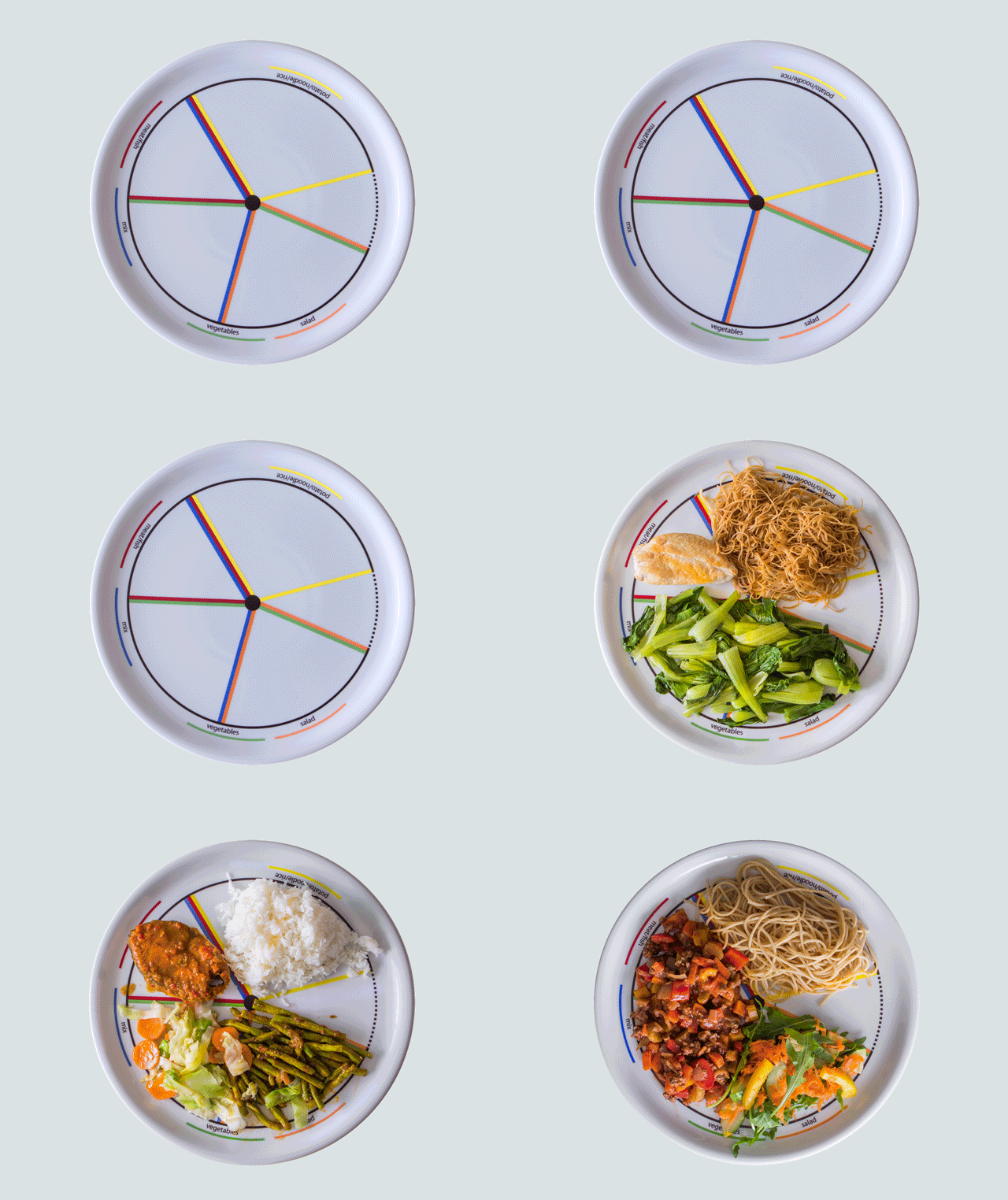
No more self-delusion. Your heaping pile of pasta isn't a diet plan—and now your plate will remind you.
It started with a simple idea: If people tend to overeat because they have trouble estimating portion sizes, why not draw portion sizes directly on a plate? Last year, Dutch designer Annet Bruil sketched out a plate that graphically illustrates a balanced meal. Now—with more evidence that the plate can actually help improve nutrition—she's ready to start mass manufacturing.
The ETE plate, which to help fund the first production run, is split into pie chart-like sections, each labeled with examples of the food you can fit inside: Salad, meat or tofu, noodles or rice, vegetables, and an overlapping "mix" section to handle the fact that most dinners combine different food groups. By limiting what you eat to what can fit in each wedge, in theory, you'll become healthier.
Coffee which looks like water. The idea behind it is that it doesn't
color your teeth, doesn't leave stains and you can drink it while its
cold.
Making clear coffee only requires two ingredients: high quality
coffee beans and clear water. When the coffee beans are processed, a
loss in caffeine is experienced. This is compensated by adding
high-quality natural caffeine. As a result the level of caffeine in your
drink can be very accurately controlled. Due to this technology a drink
has been developed which is unique in taste and flavour.
It might be hard to tell whether these beautiful Bavarian
desserts are made out of some sort of gelatin ingredient, custard or
other pudding-like recipe, but at the end of the day it doesn't really
matter. All that matters is how pretty the results are. Taking on the
form of larger cakes and smaller tarts, the Bavarian desserts have a
translucent finish that allows the colorful array of edible flower
ingredients to peak through.
Available at a bakery located in Ichibangai, a commercial area in Tokyo
station, the Bavarian desserts will inspire many food bloggers to try
their hand at similar creations. These sweet treats are especially
perfect for summer parties both outdoors and indoors.
Whole Foods is adopting a strategy similar to Wal-Mart's — offering healthcare and other services and focusing on low prices.
The retailer just opened a 45,000 square foot store near Dayton, Ohio, which includes a personal trainer on staff.
In an interview with Bloomberg last year, co-CEO John Mackey said he was thinking about offering in-store medical clinics, nutritional boot camps, cooking classes, and exercise clinics.
Offering an array of services beyond groceries could help differentiate Whole Foods from competitors like Trader Joe's and make its stores a destination.
Wal-Mart's Supercenters offer services like optometry, hair care, banking, and auto repair. The world's largest retailer has said it has a renewed focus on offering the lowest prices.
With an increasing global population and a decreasing supply of arable
land, providing sufficient food to meet demand is becoming increasingly
more difficult. Barcelona-based design practice Forward Thinking Architecture proposes an innovative solution: Smart Floating Farms. Designed to complement traditional farming, these solar-powered and modular floating farms make use of underutilized water bodies to promote long-term food security and resilience.
Dutch artist and philosopher Koert Mensvoort has launched a virtual restaurant
featuring a menu of conceptual dishes that could be made possible by
lab-grown meat – including knitted mince, a cocktail made from meat foam
and sausages grown from living pets.
There are many signs pointing to a hungry future and the Smart
Floating Farms hope to make a difference. With impending water shortages
and a exponentially growing world population, people will have to get
creative about how to grow food in the future. The Smart Floating Farms
are "automated offshore multi-layer food and energy production
platforms," the creators describe.
Designed by architect Javier F. Ponce of Forward Thinking Architecture
in collaboration with Jakub Dycha, the Smart Floating Farms will be able
to import food and water to places in need of one or both. They "are
built on freshwater lakes using layers of vegetation and mud. The wet
environment allows for a cycle of decomposition and irrigation which
fertilises the soil, creating a productive area for agriculture," writes
Munchies.


 Norman Borlaug won the Nobel Peace Prize in 1970 for his
contributions to improved farming and increased food production across
the world.
Norman Borlaug won the Nobel Peace Prize in 1970 for his
contributions to improved farming and increased food production across
the world.